By Vikas Jain | AI First Leadership Series | WorldClass TechTalent
There’s a conversation happening in every hospital corridor, every clinic, and every medical conference right now. It goes something like this: “Will AI replace doctors?”
The honest answer is no. But it will — and already is — fundamentally changing what it means to be a doctor. The physicians who thrive in the next decade won’t be those who resist AI. They’ll be the ones who learn to work with it.
Here are five ways AI is already giving doctors superpowers.
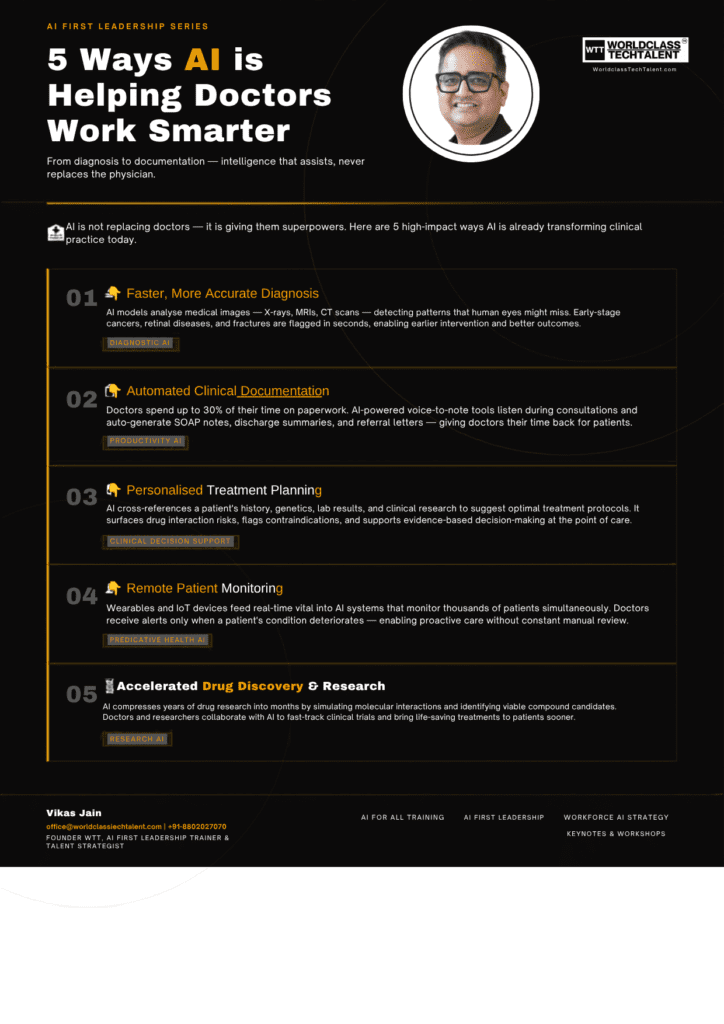
1. Faster, More Accurate Diagnosis
A radiologist reviews hundreds of scans a day. Fatigue is real. Attention drifts. A 2mm nodule on a chest CT at 7 PM on a Friday looks different than it does at 9 AM on a Monday.
AI doesn’t have that problem.
Models trained on millions of medical images — X-rays, MRIs, CT scans, retinal photographs — are now detecting early-stage cancers, hairline fractures, diabetic retinopathy, and cardiac anomalies with accuracy that matches or exceeds specialist physicians. Google’s DeepMind has demonstrated breast cancer detection outperforming radiologists. AI-assisted pathology tools are flagging cervical cancer cells in under-resourced clinics across sub-Saharan Africa where specialists simply don’t exist.
The point isn’t that AI is better than a doctor. The point is that AI plus a doctor is better than either alone. And in a world where 4.5 billion people lack access to basic healthcare, that combination could save millions of lives.
2. Automated Clinical Documentation
Ask any doctor what they hate most about their job, and documentation will feature in the top three answers. Studies consistently show that physicians spend 35–50% of their working time on paperwork — EHR entries, SOAP notes, discharge summaries, referral letters, insurance pre-authorisations.
That’s time stolen from patients.
AI-powered ambient documentation tools like Nuance DAX and Abridge now listen during a consultation (with patient consent), understand clinical context, and auto-generate structured notes that the physician reviews and approves. The entire after-visit write-up happens in seconds rather than minutes.
The downstream effects are significant: less physician burnout, more time per patient, fewer transcription errors, and faster handoffs between care teams. When a doctor can walk out of a consultation without a documentation backlog, medicine becomes humane again — for both the patient and the physician.
3. Personalised Treatment Planning
Medicine has long known that the same drug works differently in different people. Pharmacogenomics — the study of how genetics affects drug response — has existed for decades. The problem was that synthesising a patient’s genetic profile, clinical history, lab trends, contraindications, and the latest published research was beyond any single human’s bandwidth at the point of care.
AI closes that gap.
Clinical decision support systems now cross-reference a patient’s complete data profile against real-time medical literature and institutional protocols to suggest personalised treatment pathways. IBM Watson for Oncology, for all its early stumbles, pointed toward a future where every oncologist has instant access to every relevant clinical trial, every drug interaction flag, and every evidence-based protocol — not the ones they happened to read last year, but the most current ones, right now.
The result is treatment that is less generic and more precisely calibrated to the individual — which is what medicine has always aspired to be.
4. Remote Patient Monitoring
Chronic disease management is one of healthcare’s most expensive and least efficient challenges. A diabetic patient who sees their doctor once every three months and spirals in between is a system failure — costly, avoidable, and deeply human.
AI-powered remote monitoring changes the model from reactive to proactive.
Wearables and IoT-connected devices now continuously stream vitals — heart rate, blood glucose, oxygen saturation, sleep patterns, ECG rhythms — into AI systems that monitor thousands of patients simultaneously. Algorithms identify deterioration patterns before the patient feels symptoms. The doctor is alerted only when something genuinely requires their attention, rather than manually reviewing mountains of routine data.
This is especially transformative for India, where the doctor-to-patient ratio remains critically low. One physician monitoring 5,000 patients with AI assistance is a different proposition than the same physician with a clipboard and a phone.
5. Accelerated Drug Discovery and Research
The traditional drug discovery timeline runs 10–15 years from molecule to market. The cost: north of $2 billion per approved drug. Most candidates fail. The system is slow, expensive, and largely opaque.
AI is rewriting the rulebook.
During the COVID-19 pandemic, AI systems identified potential antiviral compounds in days rather than years by simulating how millions of molecules interact with the virus. DeepMind’s AlphaFold solved one of biology’s grand challenges — protein structure prediction — in a way that is already accelerating research across hundreds of diseases, from Alzheimer’s to antibiotic-resistant infections.
For doctors who also practice research or work in academic medicine, AI is not a distant future. It is an active collaborator — processing clinical trial data, identifying patient cohorts, flagging publication-worthy patterns in routinely collected hospital data that would otherwise go unnoticed.
The Bigger Picture
Every one of these applications shares the same underlying logic: AI handles the volume, pattern recognition, and information synthesis that overwhelms human cognitive bandwidth — freeing the physician to do what only a human can do. Build trust. Exercise judgement. Sit with a frightened patient and make them feel less alone.
That is not a job AI will take. It’s a job AI is making more possible.
The question for medical leaders, hospital administrators, and policy makers is not whether to adopt AI in healthcare. That question has already been answered. The question is how fast — and whether the systems you build will be designed around the physician’s intelligence or instead of it.
Vikas Jain is an AI First Leadership Trainer and Talent Strategist at WorldClass TechTalent. He works with organisations navigating AI transformation through training, keynotes, and workforce strategy. Reach him at office@worldclasstechtalent.com